The Place of Thermodynamics in Aviation
29 May 2026
The Role of Thermodynamics in Aviation
1. Introduction
Thermodynamics, in its most general definition, is a branch of science that examines the relationships between heat, temperature, work, and energy[1][2]. The conversion of energy from one form to another and the behavior of systems during these conversions are the fundamental subjects of thermodynamics. It holds a very significant place in engineering; countless systems, from household refrigerators and air conditioners to nuclear power plants and aircraft, fall within the scope of thermodynamics[3]. Historically, technologies that enabled the industrial revolution, such as the development of the steam engine in the 19th century, emerged thanks to an understanding of thermodynamic principles[4]. Therefore, thermodynamics is one of the cornerstones of many engineering disciplines, including mechanical, aeronautical, space, and chemical engineering.
2. Why Thermodynamics in Aviation?
The primary reason for the critical importance of thermodynamics in aviation is that energy conversion processes are at the heart of flight. To fly an aircraft, the chemical energy in fuel must be converted into thrust (kinetic energy). In most modern aircraft, gas turbine jet engines perform this task, functioning as energy conversion machines that operate according to thermodynamic principles. Gas turbines ideally operate on a thermodynamic cycle called the Brayton cycle: this cycle consists of isentropic compression of air in the compressor (without increasing entropy), constant-pressure heat addition (fuel energy) in the combustion chamber, and isentropic expansion in the turbine. It describes the conversion of fuel's thermal energy into mechanical work and thrust[5]. In reality, of course, compression and expansion processes cannot be perfectly isentropic due to effects like friction and turbulence; in every real process, entropy increases and losses occur, reducing efficiency[6]. Nevertheless, the Brayton cycle models the fundamental processes occurring in a jet engine, allowing us to understand energy conversion in aircraft engines.
Pressure-volume (P-V) and temperature-entropy (T-S) diagrams of an ideal Brayton cycle. 1-2: Isentropic compression (compressor), 2-3: Isobaric heat addition (combustion), 3-4: Isentropic expansion (turbine), 4-1: Isobaric heat rejection (exhaust). In a real engine cycle, due to friction and heat losses, processes cannot be perfectly reversible (isentropic), and an increase in entropy occurs[5].
Another critical role of thermodynamics in aviation relates to understanding flight principles and system design. For example, an aircraft's performance at high altitude is closely linked to thermodynamic quantities such as air temperature and pressure. Beyond the jet engine, areas where thermodynamics is applied in aviation include the state of airflow over the aircraft (atmospheric thermodynamics), cabin pressurization and air conditioning systems, and even heating problems encountered in rocket engines and hypersonic flight. Particularly in jet engines, the conversion of the chemical energy of fuel into heat, then into mechanical work and thrust, occurs in accordance with thermodynamic laws. For aircraft to operate efficiently and safely, these energy conversions must be performed with the highest possible efficiency and control, which requires thermodynamic knowledge and analysis.
3. How Does a Jet Engine Work?
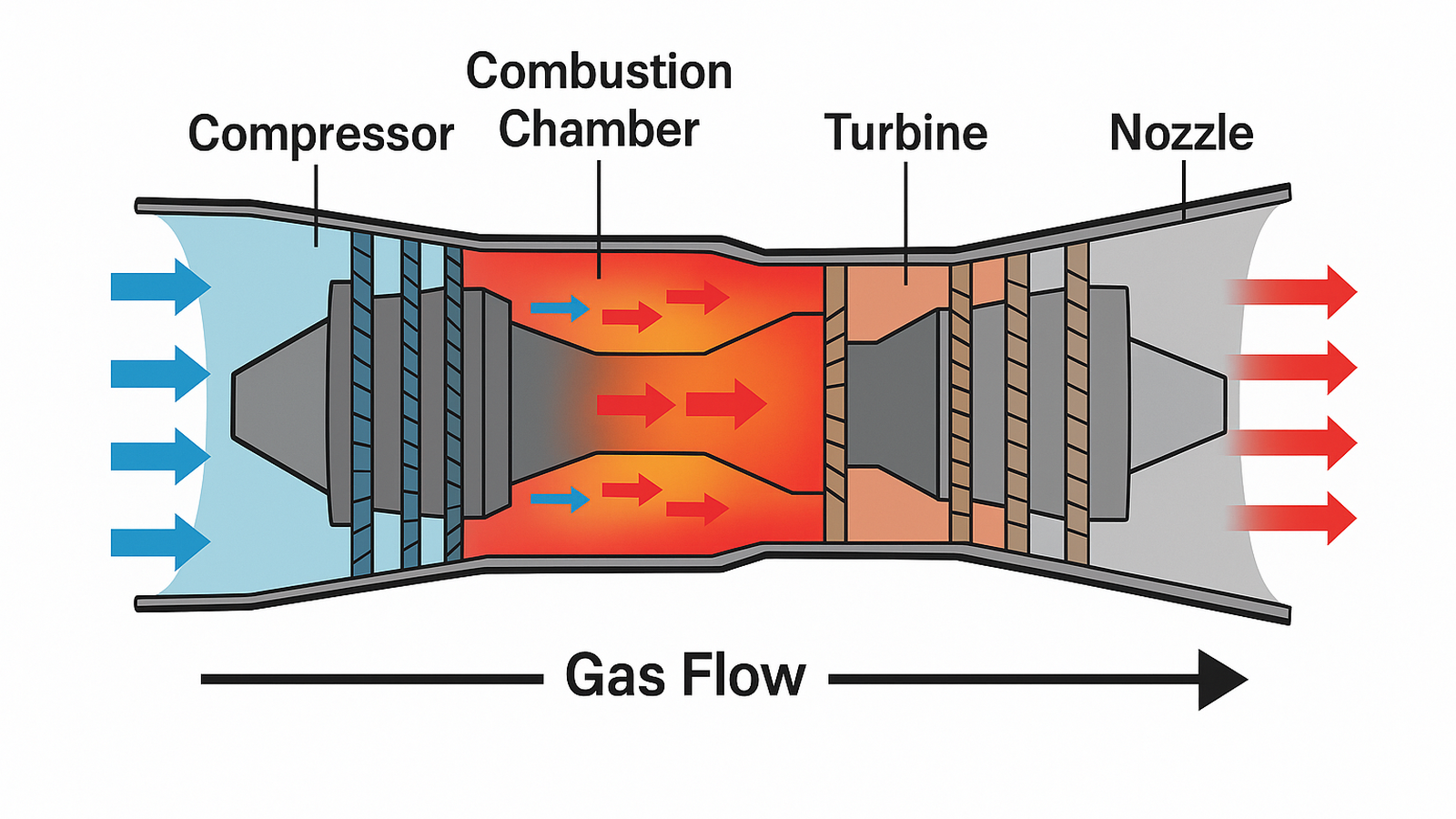
The basic components and operating principle of a jet engine: Air entering through the inlet is compressed in the compressor stages; it mixes with fuel in the combustion chamber and burns, and the resulting high-temperature gases expand in the turbines to produce work, finally exiting at high velocity through the exhaust to create thrust[7][8].
The operation of a jet engine (especially a turbofan or turbojet engine) involves sequential energy conversion steps:
- Compressor: Air entering from the front is compressed by rotating compressor fans and stages. The air's velocity is partially reduced, and its pressure is increased by a certain ratio; as a result, the air densifies, and its pressure and temperature rise significantly[9]. The work done by the compressor is provided by mechanical energy from the turbine via a shaft.
- Combustion Chamber (Combustor): High-pressure air exits the compressor and enters the combustion chamber. Here, air is mixed with fuel (e.g., jet fuel, kerosene) in pulverized form and ignited. Combustion occurs continuously, and as a result of combustion, the internal energy of the air-fuel mixture increases enormously. The temperature in a typical jet engine core can approach 2000°C, and the combustion products expand while the pressure remains nearly constant[10]. The gases exiting the combustion chamber are at very high temperature and pressure.
- Turbine: The high-pressure combustion gases are directed towards the turbine stages at the rear of the engine. The turbine, similar to the compressor, has rotor blades but works in reverse: it converts the energy of the hot gases impinging on it into mechanical rotational work. The gases strike the turbine blades, causing them to rotate, and during this process, the gas's pressure and temperature decrease while mechanical energy is produced[8]. This mechanical energy is transmitted via a shaft to the front compressor, driving it. Thus, a large part of the work done by the turbine is reused in the compressor to compress the air[5]. Despite this, the gas flow exiting the turbine is still at a higher pressure and temperature than the ambient.
- Exhaust and Thrust: The gases, having passed through the turbine and experienced a reduction in pressure, are finally expelled into the atmosphere through the exhaust nozzle. The nozzle is shaped to greatly increase the flow velocity while reducing the gas pressure to ambient pressure as it exits the rear of the aircraft[11][12]. According to Newton's laws of motion, this mass of gas ejected backward at high velocity creates the reaction force (thrust) that propels the aircraft forward[13]. Ultimately, the engine converts the fuel's energy into thrust, enabling the aircraft's movement. In modern passenger aircraft, turbofan engines additionally feature a large fan at the front of the compressor, which accelerates some of the air without passing it through the engine core, thereby increasing thrust and efficiency. However, the basic thermodynamic operation in the core section remains the same Brayton cycle described above[14][15].
The performance and efficiency of a jet engine depend on thermodynamic and material parameters such as the compressor pressure ratio, combustion temperature, and the strength of turbine materials. For example, achieving higher pressure ratios in the compressor and higher combustion temperatures theoretically yields more thrust and efficiency; however, the turbine must be able to withstand these demanding conditions. The next section will cover fundamental thermodynamic concepts that determine efficiency constraints.
4. Efficiency, Entropy, and Real Systems
Thermodynamics' second law states that no energy conversion process can be completely efficient. In other words, no heat engine can operate with 100% efficiency. This is due to the presence of irreversibilities in all real processes. Theoretically, for a machine to operate at 100% thermal efficiency, all processes must be perfectly reversible, meaning there should be no entropy-producing effects in the system such as friction, heat loss, turbulence, or viscosity. However, all processes in nature are more or less irreversible; for example, there is always some friction, and losses invariably occur, even if small, when fluids mix or heat transfers. Therefore, it is impossible in practice to convert all the energy supplied to a system into work[16]. In an automobile engine or a jet engine, only a certain percentage of the fuel's energy is converted into thrust or work; the remainder is expelled as waste heat through the exhaust, heats engine parts, or is lost to friction. For instance, a hot cup of coffee at room temperature will never spontaneously heat up; instead, it cools down – this is a result of the irreversibility of the process and heat loss to the surroundings[17]. Irreversibility means that during energy conversion in a system, some energy becomes unusable; this is the fundamental factor reducing efficiency[18].
To increase a machine's efficiency, we try to reduce irreversible losses, but eliminating them entirely is impossible. This situation is explained by the concept of entropy, introduced by the second law of thermodynamics. Entropy is roughly a measure of disorder in a system or the quality of energy in terms of its usability. The second law states that in a closed system (or the entire universe), entropy does not spontaneously decrease; instead, it either increases or, at best, remains constant. In every real process, the total entropy of the system and/or surroundings increases, which indicates that some energy quality has been degraded in that process[19]. For example, in a jet engine, part of the energy obtained from fuel combustion does thrust work, while part mixes with the environment as waste heat; this waste energy increases entropy and can no longer be converted into work. Similarly for all engineering systems, some energy transitions from a usable form to an unusable form. Therefore, even under ideal conditions, the upper limit of achievable efficiency is restricted by Carnot efficiency, and 100% efficiency is a pipe dream unless there is a heat sink at absolute zero temperature. In short, the impossibility of 100% efficiency and the continuous increase of entropy are consequences of nature's fundamental thermodynamic laws[20][19]. Engineers design systems with this reality in mind, striving to maximize efficiency by minimizing losses.
5. Connection with Aviation Materials
A used turbine blade removed from a Rolls-Royce RB199 turbojet engine (made of nickel-based superalloy material). Oxidation marks due to high temperature are visible, and small holes belonging to internal cooling channels are noticeable. Since jet engine turbines operate at extremely high temperatures, the materials used in these parts are superalloys with superior thermal resistance[21][22].
One way to increase the thermodynamic efficiency of a jet engine is to increase the temperature of the gas obtained from combustion, i.e., the turbine inlet temperature. According to the Brayton cycle, higher combustion temperatures, at the same pressure ratios, mean more work output and thus higher engine thrust efficiency. Indeed, in modern military and civil jet engines, turbine inlet temperatures have approached the 1500°C – 2000°C range in advanced engines. However, operating at such high temperatures means an extremely challenging environment in terms of materials. Among aviation materials, perhaps the most critical are those used in the "hot section" components of the engine, such as the turbine and combustion chamber. These parts must not only withstand high temperatures without melting but also maintain their mechanical strength (especially creep resistance) for long periods at high temperatures, and resist oxidation and corrosion caused by hot gases[22]. Special groups of materials developed to meet these stringent requirements are called superalloys. Nickel-based superalloys, in particular, are the primary materials preferred for turbine blades and disks in modern aircraft engines[21]. Nickel-based superalloys are alloys that can retain their strength up to a very high percentage of their melting point; for example, thanks to the `$\gamma'$ (gamma prime) precipitate phase formed with their aluminum and titanium content, they largely maintain their strength even at temperatures between 700–1000°C[23][22]. Additionally, alloying elements such as cobalt, chromium, and rhenium are added to increase their resistance to creep deformation at high temperatures and improve their ability to form a protective surface oxide layer against oxidation[22].
Jet engine turbine blades are currently produced using single crystal casting technology. This eliminates grain boundaries within the material, preventing weaknesses caused by grain boundary sliding at high temperatures[24]. Furthermore, turbine vanes are designed to be cooled by passing cold air through them (the small channel holes in the photo serve this purpose). This way, even if the flame temperature is above 1500°C, the material temperature of the blade can be kept lower through cooling. Another innovation in high-temperature materials is thermal barrier coatings: these ceramic-based coatings cover the metal surface, creating an insulating barrier between the hot gas and the material, helping to keep the material temperature ~100-200°C lower[25][26]. Thanks to all these material and cooling technologies, the thermodynamic efficiencies of jet engines have significantly increased compared to older designs. For instance, while a turbojet turbine made of steel in the 1950s could withstand temperatures of ~800°C[27][23], a modern nickel superalloy and coated turbine blade can operate at gas temperatures above 1500°C with cooling.
From a thermodynamic perspective, every material innovation that allows for higher operating temperatures carries the potential to increase cycle efficiency. However, from a materials engineering standpoint, every improvement has its limits: for example, nickel-based superalloys also have a finite lifespan and temperature limit, and this limit is being approached in turbine disks due to creep life[28]. New research at NASA Glenn Research Center has focused on improving the composition of superalloys to increase their creep resistance and slightly raise the operating temperature of turbine disks[29][30]. In the future, perhaps ceramic composite materials or next-generation superalloys capable of withstanding even higher temperatures will push the limits of jet engine efficiency further. However, no matter what material is used, the laws of thermodynamics remain unchanged: when higher temperatures are targeted for greater efficiency, innovations in materials and design, and engineering solutions aimed at managing entropy increase, will be required to make it possible. This represents the point where thermodynamics in aviation intertwines with materials science and engineering design.
References: Definition of thermodynamics and its place in engineering[1][2][3]; Gas turbine engines and the Brayton cycle[5][7]; Jet engine operating principles[31][8]; Efficiency, entropy, and irreversibility[16][32]; High-temperature superalloys and material requirements[22][28].
[1] Thermodynamics - Wikipedia
https://tr.wikipedia.org/wiki/Termodinamik
[2] [4] What is Thermodynamics? | What are the Four Fundamental Laws of Thermodynamics? | TÜBİTAK Bilim Genç
https://bilimgenc.tubitak.gov.tr/makale/termodinamik-nedir
[3] Bayburt University
https://bayburt.edu.tr/tr/termodinamik-anabilim-dali-1
[5] [6] Brayton cycle - Wikipedia
https://tr.wikipedia.org/wiki/Brayton_%C3%A7evrimi
[7] Components of jet engines - Wikipedia
https://en.wikipedia.org/wiki/Components_of_jet_engines
[8] [9] [10] [12] [13] [31] Engines
https://www.grc.nasa.gov/www/k-12/UEET/StudentSite/engines.html
[11] [14] [15] Turbine Engine Thermodynamic Cycle - Brayton Cycle
https://www.grc.nasa.gov/www/k-12/BGP/brayton.html
[16] [17] Why can't entropy be reversed? | Q&A - Evrim Ağacı
[18] [19] [20] [32] (Microsoft Word - g.alpan DÜZGÜN.doc)
http://www.ajindex.com/dosyalar/makale/acarindex-1423873786.pdf
[21] [24] Superalloy - Wikipedia
https://en.wikipedia.org/wiki/Superalloy
[22] [23] [25] [26] [27] Turbine blades and superalloys | WENZEL America
https://www.wenzelamerica.com/turbine-blades-and-superalloys/
[28] [29] [30] High-Temperature Ni-Based Superalloy Composition | T2 Portal
Comments (0)
No comments yet.